PRIORITIES FOR ENERGY EFFICIENCY AND FORGET YOU
The prodigious energy efficiency of man
 The man, with his cognitive abilities, with his imagination and his physical strength is also a marvel of efficiency: if it were an appliance would be placed in Class AA . (Indeed, for the truth, deserves a classification all its own, since no mechanical artifact is nowhere near the degree of efficiency).
 To work, in fact, on the arc of 24 hours, needs only 3400 kcal . food, that Watt converted into the equivalent of about 4 kWh : consumption equivalent of a large bulb.
A worker , under stress, as economical as a small hobby drill: 400 Wh
Yet, these days, it seems that this wonderful "article" has become obsolete , and all businesses you give great pains to eject from the production chain.
Power, the first fuel
Despite the low per capita consumption, to feed 60 million Italians are needed every day, the equivalent in food 251.2 GW h, or one third of the total power consumption required by our economy. If the absolute value may seem small, as compared to the numbers required to supply the country's enormous energy to transport goods and passengers, for heating and electricity requirements, the task that rests on the shoulders of the Italian farmers is not little, especially considering that:
- the high consumption of food in the form of animal protein, x 10 multiplies the amount of fertilizers, processing and water (and CO2 emissions) needed than those which would be sufficient to feed a population with a majority instead of a vegetarian diet. The
- Gains for Agriculture, imprisoned in the complex mechanisms speculative, it has reached unsustainable levels, forcing many players to throw in the towel and find other uses.
- the best farmland, once available to agriculture, have now disappeared under an endless flow of cement
They always say that the speculation the last 50 years has served to cement the 12% Italian soil, that that you do not specify is that such speculation has focused on the fertile lands of the plains and valleys, who have sacrificed to building more than 60% of their surface, and the remaining 40% had already assumed connotations of the residual area, from sudden urban void ( terrain vague, define them, effectively, the French)

The left image is a night of thermography satellite, identified with great accuracy, in red and black, urban areas. A quick comparison with the daytime picture on the right shows that almost all the fertile lands of the plains are lost forever.
Agriculture resists in hilly areas and disadvantaged areas where we can still produce a quality food, but not meet the food needs of 60 million inhabitants. Over the past 10 years, meat consumption in China increased by eight times, fruit and vegetables than ten times, and the UN predicts that in 2050 the Earth will be populated by 9.2 billion people, or 2, 5 billion new mouths to feed.
The phenomenon of land grabbing , that the hoarding of land by multinational companies and international investment funds (especially in Africa), which arises from the concern not have enough arable land, is spreading at a strong pace. (8 million hectares in 2009, 45 million in 2010)
everywhere except in Italy, it became clear that just about food production, through farming, you play the game for the future of the globalized world.
This country depends on foreign trade so as to estimate that, if an international crisis to stop the trade in food, our population would be starving in a few weeks.
 |
| I wonder what he would think, Angelo Piras, which is dedicated to the chilling lake of silicon, is intended to cover 29 more acres of farmland in the fertile plain of Montalto, that the slaughter is made in his name. |
Yet, with an ease that is unmatched in the rest of the world, plans to transfer a substantial portion of the remaining agricultural land from food production to electric and doing so in particular on those fertile plains and valleys, with the absurd grounds that they are easier to hide, with the help of hedges, at the sight of the keeper distracted.
The Italian, however, after hoping for a gradual reduction in the rate from the end of 2010, did vote in a Senate halved from their summer holidays, an extension of the very high incentives Contoenergia on the DL until June 2011, six months beyond the deadline, despite the drop in silicon prices occurred from 2007 to date do not justify it in any way.
have been published for some days the expectations national guidelines, which do not alter the situation much: There are two types plants on land, industrial ones, without exemption limits, even if subject to EIA or SEA, and "agricultural" to 1 MWp. The province of Grosseto
theoretically requires industrial plants to place in marginal areas, and instead sets a limit of 0.8% of common use, as if every town had the same percentage of marginal land, for the moment, however, still in Maremma does not move anything for this type of equipment in anticipation of the Region's comments to the national guidelines;
Instead of facilities "so-called agricultural" size of 1 MWp have already left, there are many ; Farmers who can afford to pay 3.5 million euro for a PV system while you have some news that, despite the stakes raised by the province with the obligation of the PMA. campaigns are beaten by brokers who acquire the rights from farmers in exchange for an unused FV rent of the land.
A real farmer would have a substantial incentive to income (€ 15,000 a year ) from a PV system in the trade regime in place, with a capacity of 20 kWp , certainly more within the reach of its assets and positioned on the roof of a barn
Sector Employment and
In recent months it feels to repeat that, if an economic recovery will be, this will be without jobs. The reason is known: capital income loves and hates labor, especially the West, with its wealth of knowledge, status of workers and unions.
For some time, investors are migrating to or from industry to finance productive activities to low need for manual labor. The estate
photovoltaic born in this light. His profit, which comes at the moment, only contributions from state, and the almost total absence of management staff, the financial returns that equates to more industrial production.
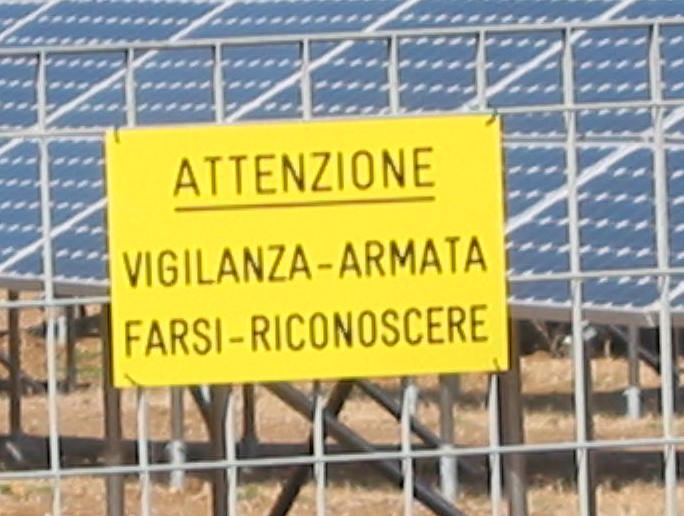 An industrial plant of the American multinational SunPower Corp. of 42 MWp and 120 hectares in Montalto di Castro visited, which cost over € 150 million, employs only a fixed 3 vigilantes, who, in 3 shifts provide 24-hour surveillance.
 maintenance is entrusted to an outside firm that is alerted by a computerized system and intervenes only in case of system problems.
The same land, which are vegetable gardens, flat and irrigated, could generate well-used, according to the provincial tables, 300,000 hours per year, ie: steady job for 125 employees , and one hundred times lower investment.
And you are not creating any industry, if not the installation of equipment, which is from the building, does not need the "know how" special and find a job only in the transient solar activity.
The raw material (panels and inverters) is almost exclusively manufactured in Asia, as well as German and English industries, created in the wake of European incentives and are relying on labor, are beginning to de-locate facilities to produce panels de-unionized countries in South Asia.
Some misleading lies on the ground FV
}
 |
| Listing Program Festambiente 2010 |
A land left natural to latitudes in spring herbaceous plants that are rapidly developing in the seed also reaching a height of 150 cm from the second year
appear brambles, gorse and thistles in excess of two meters.
Finally arrive arboreal plants.
After five years of neglect, a field, if you run into a check of the Forest Service, would be diverted out of agricultural and forestry to the past.
appear brambles, gorse and thistles in excess of two meters.
Finally arrive arboreal plants.
After five years of neglect, a field, if you run into a check of the Forest Service, would be diverted out of agricultural and forestry to the past.
After thirty, the soil would probably be covered with a soft, fresh layer of humus, but also a coppice ripe for cutting.
The only natural grass that could be maintained under the rows of panels would be recommended for organic farming orchards and olive groves, but the lawn is maintained with the help of repeated chopping, and between the rows of PV panels should be performed by hand, since the passage of a large mechanical means put at risk too fragile and expensive equipment.
Unfortunately, however, is much more likely that, once obtained the concessions made and the plants, plant growth would be contrasted with the use of herbicide. Already
regions and ASL shall authorize other non-agricultural uses, as more and more often we see, every spring, watching the grass first dyed orange and then withered in the pits of roads and highways.
 The idea that industrial facilities in PV as a transitional employment (twenty years) of agricultural land, in this image shows all his unfounded:
Yards in cement, electrical substations, and industrial buildings are a testimony to the 'irreversibility of speculative looting.

Yards in cement, electrical substations, and industrial buildings are a testimony to the 'irreversibility of speculative looting.


